
ANGADIVELA–THATHAMANGALAM: HOW THE FESTIVAL SUSTAINS INTERSTATE CULTURAL NETWORKS BETWEEN KERALA AND TAMIL NADU
June 30, 2026ROLE OF ERANAD REGION IN MALABAR REBELLION
June 30, 2026ANGADIVELA–THATHAMANGALAM: HOW THE FESTIVAL SUSTAINS INTERSTATE CULTURAL NETWORKS BETWEEN KERALA AND TAMIL NADU
June 30, 2026ROLE OF ERANAD REGION IN MALABAR REBELLION
June 30, 2026Sparkling International Journal of Multidisciplinary Research Studies
GROWTH OF KNOWLEDGE ECONOMY AND THE PROLIFERATION OF GIG EMPLOYMENT: OPPORTUNITIES AND CHALLENGES
*Nitheesh S. Babu, **Vishnu, M., S. & ***Sreejith, B.
*Research Scholar, PG & Research Department of Economics, Fatima Mata National College, (Autonomous) Kollam, Kerala, India.
**Research Scholar, PG & Research Department of Economics, Mar Thoma College Thiruvalla, Kerala, India.
***Research Scholar, PG & Research Department of Economics, Fatima Mata National College, (Autonomous) Kollam, Kerala, India.
Abstract
Indian Economy is a developing economy. During the pandemic period, extensive use of technology created a new labour market structure called the gig economy. The study examines how the knowledge economy and digitalisation promote the development of the gig economy. The emergence of a technologically driven gig market place makes it easier for job seekers to connect with gig providing companies. The Niti Aayog report reveals that the gig economy is expected to grow by 2.35 crore by the year 2029-2030. Based on the BCG report, the gig economy contributes 1.25% of India’s GDP. In India, 47 % of gig work requires medium skills. According to the Niti Aayog report, retail trade and transportation are the major gig hiring sectors in India. This conceptual work gives an overview of the ‘gig economy’. The platform-based gig work plays a vital role in India’s labour market. The gig workers enjoy many benefits such as flexibility, autonomy and independence etc. On the other hand, gig workers suffer from various challenges such as lack of job security, lack of social security and income instability. It raises the importance of policy intervention by the government for the sustained and inclusive growth of the economy.
Keywords: gig economy, niti aayog, gig workers, gig work, knowledge economy, unemployment.
Introduction
The world has entered the fourth industrial revolution, as a result, the world has witnessed a structural transformation from a traditional employment system to a non-traditional employment system. The modern economy is a credit based as well as knowledge-based economy. A knowledge economy refers to the economic system characterised by the knowledge, skill and technology are the main driving forces of economic growth and development. The skilled and educated labour force are the backbone of the knowledge economy. As a result of the digital revolution and technological advancements creates a new employment pattern in the labour market, and the emergence of a technically skilled labour class called Gig Workers (Sindhu et al., 2026). According to the Ministry of Labour employment, gig workers are those who are engaged in work in the labour market and generate income without a formal or traditional relationship between the employer and employee. Gig economy is a free-run economy without any formal commitments.
The Gig economy can operate in several forms :
- Independent Freelancers (Example, individuals registered on UrbanClap)
- Short-term contract freelancers (Example, on-demand tutors in Xylem who are paid per lecture)
- Part-time periodical workers: workers hired for a specific period (Example, guest lecturers in colleges)
- Full-time workers hired on the basis of task (Purswani and Shah,2022)
Another term associated with the gig economy is the platform economy. The platform economy is a relic of the gig economy (Niti Aayog, 2022). In this regard, the women and upcoming youth workforce are important as it is also increasing their living standards by providing a supplementary or main income stream. There are mainly two kinds of platforms: 1) web-based, 2) location-based. The web-based platform workers are those who provide their services to their different clients with the help of a website. On the other hand, the location-based platforms allow working from any specific locations, like carpooling, ridesharing, food and grocery delivery services [ILO (2021)].
Among the developing countries, India is one of the fastest-growing economies with a share of 8.4% of the Global GDP, and in 2024, 68.2% of India’s total population falls within the working age group (15–64 years), indicating a substantial proportion of the population is potentially available for economic activity. India’s economy is experiencing a strong demographic dividend and enjoys the benefits of the internet penetration. The knowledge economy is an economic system characterised by skills, technology and innovations as the major driving forces of economic growth and development. During the last decade, India has undergone a remarkable digital transformation. The State of India’s Digital Economy Report (2024) notes that India ranks as the third most digitalised economy in the world and stands 12th among G20 nations. The COVID-19 pandemic and lockdown accelerated the growth of the gig economy as the pandemic disrupted the job market, and so during this time the platform economy emerged as a viable source of income (The Hindu, 2021). Indian cities increasingly depend on gig and delivery workers to function. Food, grocery items, medicines and essential goods move through urban system because this workforce absorbs the daily risk. India is the fifth largest country in the world for flexi staffing. The top 4 countries are the US, China, Brazil and Japan (Niti Aayog, 2022). The Indian economy witnessed a huge number of graduates passing out every academic year, but the economy is not well equipped for employment generation. Moreover, in India, the labour force, particularly the younger-aged labour force, has been increasing every year. In the labour force, the unemployed workers and those who are working in the informal sector are relatively higher in the younger-aged population (Dev and Venkitanaryana, 2011). The unemployed labour class are searching for employment, and informal sector workers in the labour market are always searching for better employment opportunities. This leads to the growth of new forms of jobs called gig work in the labour market due to penetration of information technology and digital-based networks. More precisely, digitisation, internet penetration, a technologically skilled workforce, and advancements in information technology, alongside a booming startup culture, propel India’s gig economy. According to NITI AAYOG report India’s Booming & Platform-based Gig Work in 2022 states that 77 lakh workers are engaged in gig economy (Niti Aayog, 2022), and gig economy contributes 1.25% to India’s GDP (BCG, 2021). Flexibility, Level of job demands and monetary compensation are the key factors that motivated to the gig work (Jiji, 2024). Although they belong to the informal sector, gig workers are unrestricted by the law. They confront an array of difficulties as a result.
So, this study seeks to examine the transition of the economy into a knowledge economy, how it has facilitated the growth of gig economy and also analyse the types, opportunities and challenges offered by gig economy under the purview of developing economies like India.
Review of Literature
Madhurima Saha (2026) conducted a study to examine the recent changes in the labour market and highlight the importance of gig economy as the fastest-growing economy in India’s labour market. This study explores the wide range of employment opportunities provided by the gig economy for the present generation. The study was conducted on the basis of secondary data and reveals that West Bengal is recorded as the highest provider of gig workers, followed by Uttar Pradesh, in terms of the number of gig workers during 2022.
Sajina Yeshbin (2023) conducted a study. India has the largest population and a favourable age distribution and is enjoying a demographic dividend. Due to the limitations in the traditional employment sector and the growth of information and technology, the labour market witnessed a parametric shift from conventional to sharing or gig employment. The study examined the importance of gig work and found that it is increasing day by day. The gig work is the main alternative source of income and also helps marginalised workers such as women, disability persons to do work according to their own conditions. The gig work is highly elastic in nature and creates a way to promote all sectors of the economy, leading to sustained and persistent growth.
Johnson, V. (2025). The author conducted a study on the title Uberisation of Employment: A Study on Gig Workers of Kerala. The author introduced a new terminology called uberisation of employment. Uberisation of employment means increase the trend of participation of people in the gig economy through digital platforms like Uber, etc, because it offers greater flexibility. The growing unemployment rate can be tackled by the gig platform and also provides additional or supplementary income for workers. The author identified the key sectors that employ contractual labourers in Kerala as the construction industry, plantation and agriculture, hospitality and tourism, manufacturing and industry, public sector, etc. This study gives an insight into the factors that contribute to the growth of gig economy, identifies the key sectors that hire contract workers and also analyses the positive and negative impacts of gig work on the labour market.
Major reports regarding gig economy are shown in the table:
Table 1. Major reports regarding gig economy
| Study | Year | Findings |
| International labour organisation study | 2021 | The gig economy is mostly benefited to women’s but faces safety risks, pay gaps, etc. The work is entirely controlled by algorithms and digital platforms. The constant monitoring and the rating system lead to exploitation and stress on the gig workers. |
| NITI AYOG Report on Gig Economy | 2022 | In India had 7.7 million gig workers in the year 2020–21 and it is increased to 23.5 million ( 2.35 crore )by 2029- 2030 |
| Boston Consulting Group (BCG) | 2021 | Gig Economy creates massive job creation and 1.25% contributed to the India‘s GDP. India’s gig economy creates massive job creation and economic growth, but it requires strong institutional support and policy intervention to fully utilise the benefits of gig economy. |
Research objectives
- To examine the evolution of the knowledge economy and its impact on gig work in India.
- To analyse the nature, type and functioning of the gig economy.
- To explore the opportunities and challenges confronted by the gig workers.
Research Methodology
The study is done on the basis of secondary data. This study uses a systematic literature review to explore types, opportunities and challenges offered by the gig economy. The data sources are extracted from:
- Peer-reviewed journals
- Official websites
- Reports from the International Labour Organisation (ILO)and NITI Aayog.
Labour Market Evolution: Indian Knowledge System
Pre-Independence Period (Before 1947)
The pre-independence period is highly dominated by agriculture, allied sector activities and traditional occupations. At the time of Independence, most of the people engaged in the agriculture sector as a means of livelihood. The development of industry is primitive in nature. In this period, labourers mostly worked in the unorganised sector and got low remuneration. Exploitation and absence of labour rights are the striking features of this period.
Post-Independence & Planned Economy (1950–1990)
The labour market witnessed a paradigm shift from agriculture to industry and public sector growth. In India, the Planning commission was set up in the year 1950 and implemented the first five-year plan in 1951. This period indicated the predominance of the public sector and shows the highlights of the socialist economy. In this phase, the number of workers in the organised sector increased due to centralised planning. Many labour laws were implemented in order to protect the workers.
However, a large share of workers remained in the informal sector.
Economic Liberalisation Era (Post-1991)
It is the major phase after the new economic reforms of India in 1991. The new economic reforms focus on privatisation; it enables the growth of the private sector and foreign investment and establish private sector banks, which foster the development of the digital economy. Outsourcing became the outcome of globalisation, and there is a gradual increase in contractual work and a decline in the role of government and permanent jobs.
Rise of the Service & Knowledge Economy (2000s onwards)
The fourth phase starts from 2000 onwards, showing the emergence of the knowledge economy. As a result, it will lead to the growth of IT hubs like Bengaluru and Hyderabad. The knowledge economy consists of a skilled and educated labour force. It offers high remuneration for the skilled workers but widens the inequality.
Expansion of Informal & Gig Economy (2010s–Present)
Due to the rapid expansion of the knowledge economy and the digital revolution, a new work culture called gig economy. In simple words, gig economy is the blend of knowledge economy and the digital revolution. The gig economy offers flexibility and independence without any formal contact between the employer and employee. Expansion of the gig economy leads to platform-based work, especially location and web-based work. (delivery, ride-hailing, freelancing).
Gig Workers in India
Indian economy is one of the fastest-growing economies in the world. Indian economy experiences a strong demographic dividend due to the expansion of the working population. According to the Niti Aayog report (2022), around 9.9 million Indians are currently engaged in gig platforms. Moreover, India is expected to have 23.5 million gig workers by 2029-30. The below figure shows that there is an expected rise in gig workers in the coming years. It is observed that during 2024-25, there is about 1 crore gig workers in India, which is expected to rise to around 2.35 crore during 202930. (Niti Aayog, 2022)
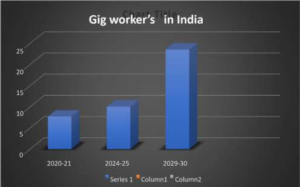
Source: Report of Niti Aayog Figure 1. Gig worker’s in India
Figure 1. Projects the workers who are employed in India’s gig economy in terms of millions. In 2020-21, 7.7 million are engaged in gig work, and it is increased by 10 million in 2024-25, and the number of workers engaged in gig economy is expected to grow to 23.7 million in 2029-30.
Sector-wise Gig-hiring
Gig workers are not suitable for all sectors. Gig workers are extremely service-oriented and concentrated in some sectors such as retailers, e-commerce, etc.
The Niti Aayog report reveals that retail trade was the dominating gig hiring sector throughout the entire period, followed by e-commerce, transportation and storage. This may be because these industries provided location-specific demand and offered a flexible staff solution by bridging the demand-supply gap of labour.
Table 2. Percentage of gig workers in the year 2019-20
| Manufacturing | 9.17 |
| Electricity, gas, steam and air condition supply | 0.33 |
| Water supply, sewage and waste management | 0.47 |
| Construction | 3.06 |
| Retail trade | 38.95 |
| Transportation and Storage | 19.18 |
| Accommodation and food services | 5.94 |
| Information and Communication | 7.39 |
| Financial and Insurance activities | 9.21 |
| Real estate activities | 3.53 |
| Administrative and support service activities | 0.55 |
| Other education group | 0.67 |
| Education support services | 1.56 |
| Total | 100 |
Source : Niti Ayog
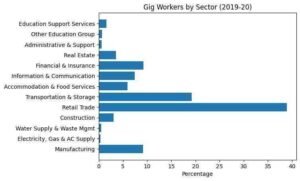
Source: Niti Aayog Figure 2. Gig Workers by Sector (2019-20)
This table and figure show the percentage of gig workers engaged under various sectors in the year 2019-20. The largest share of gig workers are engaged in retail trade and sales because it provides platform-based gig work, especially location platform-based gig work. The workers are attracted to the location platform- based work because the flexibility and autonomy of gig work will create a strong work-life balance and found that number of hours a person is able to spend with their family, and they also get time for outgoing and meet friends as a part of social gatherings, mental health and productivity (Veluchammy and Reddy, 2021).
Types and Stakeholders of Gig Economy
The gig economy can be classified into two categories: service-based gigs and knowledge-based gigs. Service-based gig work consists of low to medium-skill gig workers; they are mostly delivery agents, ride-sharing, and those who provide services through work on demand platforms. Mostly, the service-oriented workers are location-platform-based gig workers. Knowledge-based workers consist of medium-skill to high-skill workers such as web designers, data scientists, consultants, etc. Gig can be seen in every organisation, but the level of skill of workers may differ. It may influence their remuneration also (Korde et al., 2021).
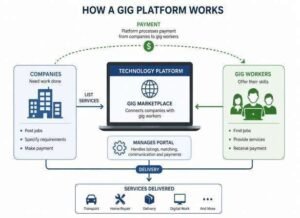
Source : Gig economy India. Figure 3. Wage Indicator (2021)
This figure shows how a gig platform works. A technology platform company acts as a central coordinator that manages an online portal. On the one side, the company list the services they need. On the other side, gig workers offer their skills to the company. The platform connects both through a market place called gig market place. It is a marketplace in which work is matched with skill. Once the work is done by the worker, the payment flows from companies to gig workers through the platform. The final output is the delivery of various services. Here, the platform acts as an intermediary which link demand with supply and delivers services efficiently.
There are four stakeholders in gig economy:
- Technology platform companies: It plays an important role in expanding the role of gig economy in modern labour dynamics. It facilitates the link between the producer and consumer and also provides flexible working schedules to workers.
- Gig Workers: The gig economy creates opportunities for people to earn extra or supplementary income. Here, employees have the freedom to select their own work schedule, which gives them control over their compensation and working hours. Consequently, it promoted women’s involvement in the gig economy. (Banik, 2020).
- Companies: The rapid expansion of gig economy benefited job providers i.e. companies. The company can hire workers form cost effective method with no long-term commitments. Companies hire individuals to perform specialized task to avoid administration and compliance costs.
- Government: Government act as a mediator between the two stakeholders-gig workers and Companies.
Change in Gig Economy Skill Pattern
A Niti Aayog study on ‘ India ‘s booming gig and platform economy” reported that 47% of gig work is in medium-skilled jobs, 22% are in high skilled and 31% are in low-skilled jobs.
- Low-skilled gig workers are typically engaged in service-oriented tasks that do not require specialised knowledge. Example: Ride-sharing workers and delivery personnel.
- 47%- a large share of gig workforce is medium-skilled. They are equipped with medium knowledge and training in their field, but they do not require intensive knowledge and training. Example: Electricians and plumbers.
- 22% of workers constitute high skilled work force. In this job, the workers are well equipped with advanced knowledge, experience, specialised qualifications, and skills. Example: software developers and graphic designers.
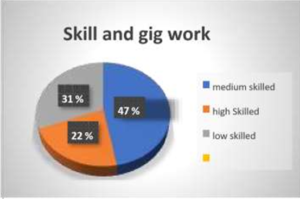
Source : NITI Aayog Figure 4. Percentage of skill in gig work
Opportunities or Gains of Gig Work
- Work-Flexibility: The gig economy will help us preserve work-life balance or academic-life balance since it gives gig workers more flexibility. The flexibility of not being constrained by tight attendance regulations or a set of time schedules.
- Autonomy: Gig Workers enjoys Autonomy. It means there is no control or supervision of employer in their work.
- Independence: Gig workers are highly independent in nature. Gig workers done their tasks without any formal contact between the employer and employee.
- Supplementary Income: The gig economy provides additional revenue. To supplement their income from regular jobs or other sources, many people work part-time gigs.
- Cost saving: Organisations can employ short-term or part-time workers; it will reduce the expenses associated with the employment of full-time workers.
- Economic Services: Businesses are able to provide services to customers more affordably via the gig economy.
- Skill Development: The gig economy is essential to the development of skills and careers. People, especially young undergraduates, can get useful experience and build skills that will enhance their employability in the future by engaging in gig employment.
Challenges or Drawbacks of Gig work
- Lack of job security: Compared to traditional employment, gig work is uncertain and offers no job security. Lack of work security will result in complicated future planning and financial uncertainty.
- Instability of income or irregular income: Gig workers income are not stable in nature. They get remuneration on the basis of their task done by them. So, it may increase or decrease. Gig workers in India frequently experience income variations due to the erratic and unpredictable nature of gig labour.
- No benefits: Social security benefits like health care, paid time off, and retirement benefits are not available to gig workers.
- Lack of Formalisation: The majority of gig workers are employed in informal employment, which limits their access to government aid programs, credit, and other necessary resources.
- Isolation: Gig workers work alone and lack a regular office setting, professional support network, and social connection.
- Unsatisfactory Social Security and Legal Protection: Because gig workers are not protected by India’s labour laws, they are susceptible to discrimination, harassment, and wrongful termination.
- Social discrimination: Gig work is viewed as temporarily or low-paying in India, which will result in social discrimination and a failure to acknowledge the contributions made by gig workers.
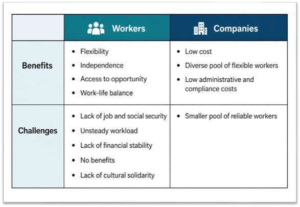
Source: Gig economy India. Figure 5. Wage Indicator (2021)
The Prospectus of Gig Economy in India
On January 29, 2026, our Union Ministry of Finance, Nirmala Sitharaman, raised the need of reconstructing the gig economy because it encompasses the growing workforce and increase the challenges it faces. The Economic survey of India 2025-26 stated that the gig sector workers increased from 7.7 million in 2021 to 12 million in 2025. This growth is mainly driven by smartphone usage, with over 800 million users and recorded around 15 billion Unified Payment Interface transactions per month. According to the NITI Aayog’s report, India may have 2.3 crore gig workers by the year 2030. The last six months witnessed a growth in demand for skilled gig workers; it raises the popularity of gig economy in India and significantly changed the economic landscape also. But the growth of gig economy alarms policymakers to find ways to overcome the challenges.
Findings
- The knowledge economy plays a significant role in the emergence of the gig economy.
- In India, more than 1 crore workers are employed in Gig work.
- Gig economy contributes 1.25% of India’s GDP.
- The most popular industry in India for gig hiring is retail trade.
- The majority of gig workers are engaged in medium-skilled gig work.
- The gig marketplace is a technological platform that connects the gig hiring companies and gig workers.
- The gig economy offers many opportunities; therefore, these opportunities are the main highlights that substitute the conventional employment system.
- Gig workers confront a number of issues, including unstable employment, a lack of social security, inconsistent pay, and a lack of attention from the government.
Suggestions
- Now gig economy is an important segment of the informal sector. Therefore, the government should take initiatives for the legal protection of gig workers. Establish clear regulatory frameworks to define gig workers’ rights, ensuring fair wages and protection against exploitation.
- Ensure social security measures, it will eliminate financial instability. Also ensure access to basic benefits such as health insurance, pension schemes, and accident coverage.
- Most of the gig workers are medium-skilled and low-skilled. Therefore, the gig companies or the government should take an initiative to provide skill development, especially in digital, analytical, and communication skills, to match the needs of the knowledge economy.
- Boost-up the access to high-speed internet and other digital tools in rural areas; it will lead to an increase in the participation of workers in gig economy.
- Integration of public, private and educational institutions will create a supportive ecosystem for gig work.
Conclusion
The Gig economy has emerged as a significant component of the modern labour market because of the booming of digitalisation and the knowledge economy. The gig economy has unlocked a new work culture in the labour market by creating flexibility and new income opportunities. At the same time, it raises serious concerns such as a lack of job security, income instability and lack of social protection, etc.
In conclusion, even though the gig economy promotes flexibility and economic dynamism, it also calls on the government to effectively intervene in policy to guarantee minimum wage requirements, improved working conditions, and social safety. In summary, the gig economy is the result of the knowledge economy and digital revolution.
References
Banik, N. (2020). India’s gig economy needs affirmative policy push. ET Government. https://government.economictimes.indiatimes.com/news/economy/opinion–indias-gigeconomy –needs–affirmative-policy–push/7312 1847
Dawle, A., & Mishra, P. K. (2025). The role of AI in shaping the future of the gig economy: A study of gig workers in urban India. International Journal of Social Sciences and Management. https://doi.org/10.3126/IJSSM.V12I3.82350
Dev, S. M., & Venkatanarayana, M. (2011). Youth employment and unemployment in India. Indira Gandhi Institute of Development Research.
Government of India. (2022). India’s booming gig and platform economy. NITI Aayog. https://www.niti.gov.in/sites/default/files/2023-06/Policy _Brief_India%27sBooming_Gig_and_Platform_Economy27062022.pdf
International Labour Organisation. (2021). World employment and social outlook: Trends. International Labour Office.
Jiji, K. P. (2024). An analysis of gig economy in Kerala. De Paul Journal of Scientific Research, 9(1).
Johnson, V. (2025). Uberisation of employment: A study on gig workers of Kerala. International Journal of Creative Research Thoughts (IJCRT), 13(2). http://www.ijcrt.org/
Karunakaran, N. (2025). The gig economy in India. Journal of Management Research and Analysis, 12(1), 67–73.
Korde, R., Agarwal, P., Adimulam, D., & Gandhi, M. (2021). Gig economy India. Wage Indicator. https://www.drishtiias.com/daily–updates/daily–news–editorials/future–ofindiasgig–work
Mehta, B. (2020). Future of work: The emerging gig economy.
Ministry of Labour and Employment. (2021). E-Shram portal launched for registration of unorganised workers. Government of India. https://labour.gov.in/whatsnew/eshramportallaunchedregistration-unorganised-workers
Mishra, R., K. (2026). A study of new insight at gig economy in Indian scenario.
Purswani, N., & Shah, K. (2023). Gig economy of India from HRM perspective: The road ahead for HR managers with special reference to NITI Aayog’s report, June 2022. In Reimagining management in the post VUCA world (p. 131).
PWOnlyIAS. (n.d.). Gig economy in India. https://pwonlyias.com/currentaffairs/gigeconomyin-india/
Reddy, P., & Veluchamy, D. R. (2021). A study on work life integration of gig workers. Eureka Publications.
Saha, D. M. M. (2026). Gig economy in India: An analysis with survey data. International Journal of Contemporary Research in Multidisciplinary. https://doi.org/10.5281/ZEN ODO.18898044
Saha, M. (2026). Gig economy in India: An analysis with survey data. International Journal of Contemporary Research in Multidisciplinary, 5(2), 79–85.
Sajina, Y. (2023). Expansion of gig and platform economy in India. GAS Journal of Multidisciplinary Studies, 1(2). GAS Publishers.
Salunkhe, D. H., & Patil, H. (2022). Review on gig economy in India and its rise.
Sindhu, N., Nambiar, N. V., Sana, F. V. K., & Karunakaran, N. (2026). Socio-economic conditions, work pattern and satisfaction among gig workers in Kannur district of Kerala, India. International Journal of Research in Commerce and Management Studies (IJRCMS), 8(2), 504–525.
The Times of India. (2024). Tech gig economy grows, India to have 23.5 million workers by 2030. https://timesofindia.indiatimes.com/city/bengaluru/techgig-economy-gro wsindiatohave-23-5-million-worker s-by-2030/articleshow/111048791. cms
Zenodo. (2023). Expansion of gig and platform economy in India. CERN European Organisation for Nuclear Research.
To cite this article
Nitheesh S. Babu, Vishnu, M., S., Sreejith, B. (2026). Growth of Knowledge Economy and the Proliferation of Gig Employment: Opportunities and challenges. Sparkling International Journal of Multidisciplinary Research Studies, 9(2), 11-24.