
WHOLE-LIFE ASSET MANAGEMENT AND CIRCULAR ECONOMY PRINCIPLES FOR PUBLIC-PRIVATE PARTNERSHIPS (PPPs): TOWARDS SUSTAINABLE INFRASTRUCTURE
December 31, 2025WHOLE-LIFE ASSET MANAGEMENT AND CIRCULAR ECONOMY PRINCIPLES FOR PUBLIC-PRIVATE PARTNERSHIPS (PPPs): TOWARDS SUSTAINABLE INFRASTRUCTURE
December 31, 2025Sparkling International Journal of Multidisciplinary Research Studies
COST STRUCTURE AND PROFITABILITY OF PEPPER AND CARDAMOM CULTIVATION IN KERALA: A COMPARATIVE ANALYSIS
*Jiya Tom, & **Geevarghese M. Thomas
*Research Scholar, Department of Economics, Catholicate College, Pathanamthitta, Kerala, India.
**Assistant Professor, Department of Economics, K.G. College, Pampady, Kottayam, Kerala, India.
Abstract
Pepper and cardamom are two of the most important plantation spice crops cultivated in Kerala, contributing significantly to farm income, rural employment, and export earnings. However, cultivation of these crops is increasingly characterised by rising production costs and heightened economic risk. This study examines and compares the cost structure and profitability of pepper and cardamom cultivation in Kerala using secondary cost of cultivation data for the period 2019–20 to 2021–22. Standard cost concepts, namely Cost A, Cost B, and Cost C, are employed to analyse item-wise expenses, labour intensity, and inter-year changes in cultivation costs across different holding size classes. Profitability is assessed using the value of output per hectare and benefit–cost ratios. The results reveal that hired human labour constitutes the dominant component of cultivation costs in both crops, highlighting their labour-intensive nature. While pepper cultivation exhibits higher cash profitability under Cost A, cardamom cultivation generates a higher gross value of output but is associated with substantially higher cultivation costs. The comparative analysis underscores important differences in cost composition, labour participation, and economic returns between the two crops. The study emphasises the need for targeted policy interventions aimed at reducing cost pressures, improving productivity, and strengthening income stability for spice cultivators in Kerala.
Keywords: cost of cultivation, profitability, pepper, cardamom, benefit–cost ratio, kerala.
Introduction
Pepper and cardamom are among the most important plantation spice crops in Kerala and play a significant role in farm income generation and rural employment. Cultivation of these high-value spices is largely undertaken by small and marginal farmers and is characterised by intensive labour and input use. In recent years, pepper and cardamom cultivation has faced increasing economic pressure due to rising costs of production, particularly those associated with human labour and farm inputs. Unlike seasonal crops, plantation crops require year-round management, resulting in sustained expenditure on labour, nutrient application, plant protection, and maintenance operations. Escalating wage rates and input costs have therefore raised concerns regarding the economic viability of spice cultivation in Kerala.
An analysis of the cost structure and profitability of spice crops is essential for assessing their economic efficiency and sustainability. While existing studies have largely focused on trends in production and export performance, comparatively fewer studies have undertaken a systematic comparison of the economic performance of pepper and cardamom using standard cost concepts.
Against this backdrop, the present study examines and compares the cost structure and profitability of pepper and cardamom cultivation in Kerala using officially published cost of cultivation data. By employing standard cost concepts and benefit–cost analysis, the study seeks to provide empirical evidence on the economic efficiency of these two major spice crops and to draw policy-relevant insights for sustaining spice cultivation in the state.
Objectives
- To analyse and compare the cost structure of pepper and cardamom cultivation in Kerala.
- To assess the profitability of pepper and cardamom cultivation using standard cost concepts.
- To examine recent changes in cultivation costs of pepper and cardamom.
Hypotheses
- H1: There is no significant difference in the cost structure of pepper and cardamom cultivation.
- H2: There is no significant difference in the profitability of pepper and cardamom cultivation.
- H3: There is no significant change in the cost of cultivation of pepper and cardamom over the study period.
Data and Methodology
Data Sources
The study is based entirely on secondary data on the cost of cultivation of pepper and cardamom in Kerala. Crop-wise cost data were collected from the officially published Cost of Cultivation of Important Crops in Kerala reports of the Department of Economics and Statistics, Government of Kerala. The analysis primarily uses data for the agricultural year 2021–22, which represents the latest officially available cost of cultivation estimates for these plantation crops. To examine recent changes in cultivation costs, data for the years 2019–20 and 2020–21 were also utilised wherever available.
Cost Concepts
The study employs standard cost concepts commonly used in agricultural economics to assess economic efficiency:
- Cost A: Includes actual paid-out costs such as hired human labour, inputs, machinery charges, and interest on working capital.
- Cost B: Cost A plus rental value of owned land and interest on fixed capital.
- Cost C: Cost B plus imputed value of family labour.
These cost concepts enable an assessment of both cash profitability (Cost A) and full economic profitability (Cost C).
Measures of Profitability
Profitability of pepper and cardamom cultivation is assessed using:
- Value of Output per hectare, as reported in the cost of cultivation data.
- Benefit–Cost (B:C) Ratio, computed as:
B:C ratios are estimated under different cost concepts to capture variations in economic returns.
The analysis is primarily comparative and descriptive in nature. Item-wise cost components are examined to understand the cost structure and relative importance of labour and material inputs in pepper and cardamom cultivation. Inter-year changes in cultivation costs are analysed using percentage changes to identify recent cost trends. Comparative results are interpreted to examine differences in cost structure, labour intensity, and profitability between the two crops.
Limitations of the Study
The study is constrained by the availability of officially published cost data, with 2021–22 being the most recent year for which complete estimates are available. The analysis is based on secondary data and does not incorporate farm-level primary information; however, the data used are widely accepted in agricultural economics literature and provide a reliable basis for comparative analysis.
Cost Structure and Profitability of Pepper and Cardamom Cultivation
Cost Structure of Pepper and Cardamom Cultivation
Table 1 presents the cost of cultivation per hectare for pepper and cardamom in Kerala for the year 2021–22 based on standard cost concepts.
Table 1. Cost of Cultivation of Pepper and Cardamom (ha), 2021–22
| Crop | Cost A | Cost B | Cost C |
| Pepper | 95,005 | 2,32,747 | 7,50,860 |
| Cardamom | 2,23,807 | 3,09,966 | 3,73,663 |
The results indicate substantial differences in the cost structure of pepper and cardamom cultivation. Cardamom cultivation involves a significantly higher paid-out cost (Cost A) compared to pepper, reflecting its intensive input and labour requirements. Pepper exhibits a much lower Cost A but a considerably higher Cost C, largely due to the imputed value of family labour and land.
Composition of Cost of Cultivation of Pepper and Cardamom
Understanding the composition of cultivation cost is crucial for identifying the major cost drivers and assessing economic pressure points in spice cultivation. Figure 1 presents the percentage share of major cost components in total cultivation cost for pepper and cardamom in Kerala during 2021–22.
Table 2. Percentage Share of Major Cost Components
| Cost Component | Pepper(%) | Cardamom(%) |
| Human labour | 62.89 | 52.29 |
| Manure & fertilisers | 19.79 | 16.24 |
| Plant Protection | 8.46 | 11.87 |
| Other costs | 8.86 | 19.60 |
| Total | 100.00 | 100.00 |
Figure 1. Percentage Share of Major Cost Components
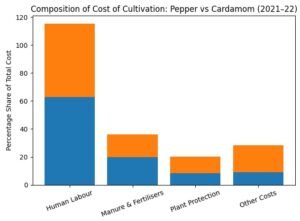
Note: Percentages represent the share of major cost components in total cultivation cost. Source: Department of Economics and Statistics, Government of Kerala.
The cost composition analysis reveals that human labour constitutes the single largest component of cultivation cost in both pepper and cardamom, confirming the highly labour-intensive nature of spice cultivation in Kerala. However, the relative importance of labour differs across crops. In pepper cultivation, labour accounts for nearly two-thirds of the total cost (62.89 percent), indicating a stronger dependence on hired labour operations such as harvesting, weeding, and maintenance. In contrast, labour accounts for 52.29 percent of the total cultivation cost in cardamom.
Manure and fertiliser expenses form the second largest cost component in both crops, accounting for 19.79 percent in pepper and 16.24 percent in cardamom, reflecting the nutrient-intensive nature of plantation spice crops. Expenditure on plant protection chemicals is relatively higher in cardamom cultivation, highlighting greater vulnerability to pests and diseases and the need for repeated plant protection operations.
The share of other costs, including interest on capital and miscellaneous expenses, is notably higher in cardamom cultivation compared to pepper. This suggests a higher overall cost burden and financial exposure associated with cardamom farming.
Overall, the composition of cultivation cost indicates that labour and input costs jointly dominate total expenditure in both crops. Rising wage rates and input prices, therefore, pose significant challenges to the economic sustainability of pepper and cardamom cultivation in Kerala.
Economic Efficiency of Pepper and Cardamom Cultivation
Economic efficiency of pepper and cardamom cultivation is assessed using the benefit–cost (B:C) ratio, which measures the relationship between the value of output and the cost of cultivation. In the present study, economic efficiency is analysed under Cost A, as it reflects cash profitability and short-run economic performance, which is most relevant for farmers’ decision-making.
Table 3. Economic Efficiency of Pepper and Cardamom Cultivation in Kerala, 2021–22
| Crop | Value of Output(ha) | Cost A (ha) | B:C Ratio |
| Pepper | 2,30,770 | 95,005 | 2.43 |
| Cardamom | 3,57,523 | 2,23,807 | 1.60 |
Note: The benefit–cost ratio is computed under Cost A to reflect cash profitability. Cost C, which includes imputed family labour and land value, is used only for assessing long-run economic cost.
The results of the benefit–cost analysis indicate clear differences in the economic efficiency of pepper and cardamom cultivation in Kerala. Pepper cultivation records a higher benefit–cost ratio of 2.43, implying that every rupee of cash expenditure generates Rs. 2.43 of output. This reflects relatively strong cash profitability and lower cost exposure in pepper cultivation.
In contrast, cardamom cultivation, despite generating a higher value of output per hectare, records a lower benefit–cost ratio of 1.60. The comparatively lower economic efficiency of cardamom cultivation can be attributed to its substantially higher cultivation costs, particularly expenditure on labour and plant protection operations. These results suggest that cardamom cultivation involves greater economic risk and higher dependence on favourable output prices to remain profitable.
The analysis reveals that pepper cultivation is relatively more economically efficient than cardamom cultivation in terms of cost–return performance, while cardamom cultivation, though high-value, is more cost-intensive. This highlights the importance of cost-reducing measures and productivity-enhancing interventions, especially for cardamom farmers.
Conclusion and Policy Implications
The study presents a comparative assessment of the cost structure and economic efficiency of pepper and cardamom cultivation in Kerala using officially published cost of cultivation data. The findings indicate that cultivation of both crops is highly labour-intensive, with human labour constituting the largest share of total cultivation cost. This underscores the vulnerability of spice cultivation in Kerala to rising labour costs and changing labour availability.
The economic efficiency analysis reveals clear differences between pepper and cardamom cultivation. While cardamom cultivation generates a higher value of output per hectare, it is associated with substantially higher cultivation costs. As a result, pepper cultivation exhibits greater economic efficiency, reflected in a higher benefit–cost ratio under Cost A. This indicates that pepper offers relatively better cost–return performance in terms of cash profitability, whereas cardamom cultivation involves higher cost exposure and economic risk.
The analysis further shows that cultivation costs for both crops have increased over recent years, intensifying economic pressure on spice farmers. Labour costs and input expenses emerge as the major contributors to this increase, highlighting the need for interventions that improve cost efficiency and resource use.
From a policy perspective, the results suggest that efforts to sustain spice cultivation in Kerala should focus on reducing cost pressures and improving productivity rather than relying solely on output expansion. Promotion of labour-saving technologies, improved access to quality inputs, and strengthened extension services can enhance economic efficiency, particularly for high-cost crops such as cardamom. Measures aimed at improving cost management and operational efficiency would contribute to greater income stability and long-term sustainability of spice cultivation in the state.
References
Department of Economics and Statistics (DES), Government of Kerala. (2022). Cost of Cultivation of Important Crops in Kerala 2021–22. Thiruvananthapuram: DES.
Department of Economics and Statistics (DES), Government of Kerala. (2021). Cost of Cultivation of Important Crops in Kerala 2020–21. Thiruvananthapuram: DES.
Department of Economics and Statistics (DES), Government of Kerala. (2020). Cost of Cultivation of Important Crops in Kerala 2019–20. Thiruvananthapuram: DES.
Government of India. (2023). Agricultural Statistics at a Glance. New Delhi: Ministry of Agriculture and Farmers Welfare.
Cuddy, J. D. A., & Della Valle, P. A. (1978). Measuring the instability of time series data. Oxford Bulletin of Economics and Statistics, 40(1), 79–85.
Singh, R. P., & Singh, B. (2012). Cost of cultivation and farm profitability: A study of plantation crops in India. Indian Journal of Agricultural Economics, 67(3), 365–377.
Birthal, P. S., Joshi, P. K., & Gulati, A. (2005). Vertical coordination in high‐value commodities: Implications for smallholders. International Food and Agribusiness Management Review, 8(1), 1–18.
Rao, C. H. H. (2005). Agriculture, food security, poverty and environment. Oxford University Press, New Delhi.
Spices Board India. (2023). Spice Statistics. Kochi: Ministry of Commerce and Industry, Government of India.
To cite this article
Jiya Tom, & Geevarghese M. Thomas. (2025). Cost Structure and Profitability of Pepper and Cardamom Cultivation in Kerala: A Comparative Analysis. Sparkling International Journal of Multidisciplinary Research Studies, 8(4), 58-64.